
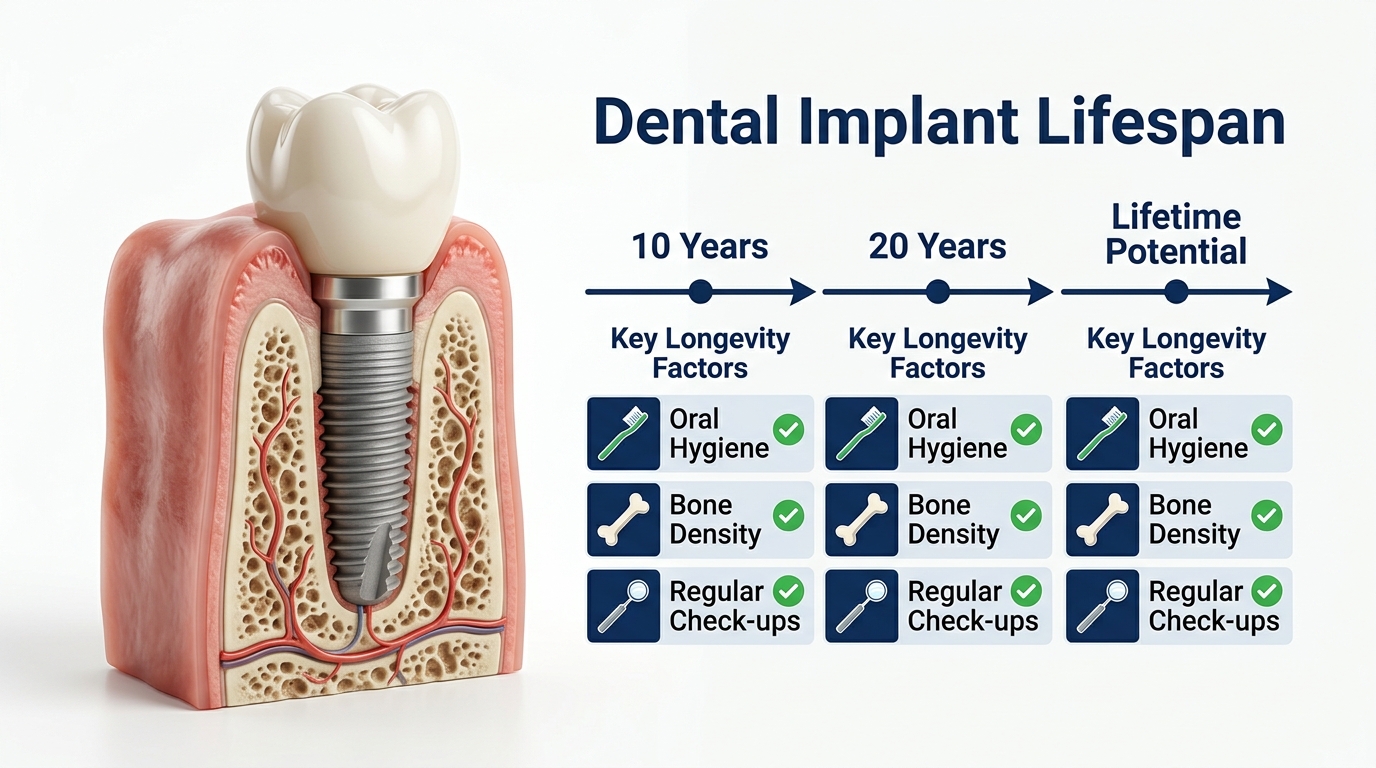
How long do dental implants last? This is usually the first question on the mind of those with missing teeth considering dental implants. No dental implant restoration will last forever, but the lifespan of an implant is dependent on multiple factors. These factors include: oral hygiene, overall health and strength of the bones, lifestyle, overall oral health, and the type of restoration attached to the implant.
Research studies involving modern dental implants show very positive long-term results. One systematic review calculated an implant level 10-year survival rate of approximately 96.4%. Another study involving reviews with at least 10 years of follow up calculated a cumulative mean survival of about 94.6%. However, survival does not equate to a lifelong guarantee of an implant.
The key takeaway here is, dental implants have the potential to last a lifetime, but in order to be successful they need to be planned and placed properly and regularly monitored and maintained by a dental professional.
Quick Answer: How Long Do Dental Implants Last?
A well-maintained dental implant can be expected to last 10 years. Some may even last 20 years or more. While there is little guarantee of implant longevity, technically dental implants can last a lifetime.
You should also know that a dental implant is made of several parts: a titanium implant fixed in the jawbone, an abutment, and a crown/restoration. The dental implant and the restoration of choice can have different lifespans.
- 10 years: Many dental implants function successfully for this period of time.
- 20 years: Some dental implants function successfully for this period of time.
- Lifetime: This is possible for some patients with optimal hygiene and care.
- Crown/restoration: Can need repair, maintenance, or replacement before the implant itself does.
Dental Implant vs. Implant Restoration Lifespan
Many people believe the entire dental implant is a single-piece component. However, it consists of three parts: the implant fixture, abutment, and crown. The implant fixture itself remains in the jawbone for many years. Therefore, the failure or wear of a crown does not mean the dental implant itself has failed.
Component Breakdown vs. Restoration Lifespan
• Implant Fixture: Holds the replacement tooth to the jawbone (Can function for many years / decades)
• Abutment: Connects the implant to the restoration (May need adjustment or replacement over time)
• Crown/Bridge: Replaces the visible tooth structure (Can wear, chip or break and need replacement eventually)
• Supporting Bone and Gums: Provide biological support (Can be impacted by infection, inflammation, or hygiene)
Can Dental Implants Last a Lifetime?
Dental implants often last a lifetime, but they can't be marketed as permanent treatments. Biological and mechanical health, implant placement precision, oral hygiene, and patient compliance all affect longevity.
Gum health, bone health, good oral hygiene, regular check-ups, and healthy lifestyle habits combined with professional care lead to long-term success. Conversely, untreated gum disease, smoking, poor hygiene, and teeth grinding increase failure risk.
What Affects the Lifespan of Dental Implants?
The longevity of a dental implant is impacted by several key clinical and lifestyle factors:
- Quality and Quantity of Jawbone: Sufficient bone support is essential; bone grafting may be recommended if bone atrophy has occurred.
- Oral Hygiene and Gum Health: Bacterial plaque buildup around implants can lead to peri-implantitis and bone loss.
- Smoking and Tobacco Use: Impairs blood flow, delays surgical healing, and significantly increases failure rates.
- Implant Placement & Treatment Planning: Precise positioning relative to jawbone, nerves, and adjacent teeth is critical.
- Bite Force & Teeth Grinding (Bruxism): Excessive forces put stress on implant crowns; protective night guards may be advised.
- Regular Dental Maintenance: Routine check-ups catch minor soft tissue or mechanical issues before they turn serious.
Your Implant Longevity Checklist
Take these proactive steps before and after your implant procedure to maximize your implant investment:
- Before Treatment: Complete oral evaluation, disclose gum disease history, discuss medical conditions, and report tobacco or grinding habits.
- After Treatment: Brush twice daily, clean interdentally around implants, keep recall visits, avoid biting hard objects, and report pain or looseness immediately.
Failure of Dental Implants & Warning Signs
Although rare, dental implant failure can occur due to biological, mechanical, or hygiene factors. Red flags include persistent pain, inflammation, bleeding upon brushing, discharge, swollen gums, loose crowns, or bite changes.
If an implant feels loose or painful, seek prompt evaluation from your dentist—many issues can be corrected early without requiring implant removal.
What to Expect After 10 to 20+ Years
Long-term research shows high survival rates at the 10-year mark (94–96%+). Beyond 10–20 years, routine monitoring remains vital as natural aging, bone remodeling, and mechanical wear on crowns continue over time.
For an implant to remain healthy, routine check-ups and early intervention ensure your investment continues serving you comfortably.
Why Consider Dentacare for Dental Implants in Bilekahalli, Bengaluru?
At Dentacare in Bilekahalli, Bengaluru, our multidisciplinary team provides complete implant diagnostics, precise placement, custom restorations, and long-term preventive care to ensure your implants remain strong and healthy for decades.
Frequently Asked Questions
How long will my dental implant last?
With proper care and maintenance, there is no reason why a dental implant cannot last 10 years or more, with many lasting several decades.
Can dental implants last a lifetime?
Some implants have been known to survive a lifetime, but no dentist can guarantee a lifetime survival due to individual health and biological changes.
Do dental implants need to be replaced?
There is no routine replacement date for the implant fixture inside the bone, but crowns, abutments, or other upper components may eventually need maintenance or replacement.
What causes dental implants to fail?
Failure can occur as a result of infection (peri-implantitis), poor bone integration, excessive bite forces from grinding, smoking, or trauma.
How can I make dental implants last longer?
Maintain daily brushing and interdental flossing, visit your dentist regularly for professional check-ups, avoid tobacco, and wear a guard if you grind your teeth.
Are dental implants permanent?
While dental implant restorations are fixed and designed to last for decades, they are not completely immune to wear, inflammation, or damage over time.
What is the success rate of dental implants?
Long-term studies show that dental implants are highly successful, with systematic reviews showing approximately 96.4% functioning after 10 years.