Losing a tooth means far greater implications than having a less pretty smile. Tooth loss can change the way you chew, the way you speak, and how you dish out the grin. And even more, it can let the surrounding teeth to migrate and change the way the rest of your teeth meet and interact. However, nothing is hopeless. With the expansion and advancements of modern dentistry, there are multiple options for reliable tooth replacements such as dental implants, bridges, and dentures.
The number of missing teeth, oral health, and bone health will substantially impact decision making between dental implants or bridges, and dental implants or dentures, and between dental bridge versus dentures. Of course, budget, personal lifestyle, and how long you intend to keep your tooth replacement will play an important role as well.
This tooth replacement guide will help you answer which tooth replacement method is the most appropriate for your situation.
What is the Best Tooth Replacement?
Because dental implants are a more surgical option, they are gradually becoming the new personal standard for tooth replacement. This is usually the case for replacing one or multiple individual missing teeth. However, this is not a blanket statement. An otherwise healthy individual with good bone structure may still choose a dental implant, however, someone with generally poorer overall health or bone structure may opt for a denture instead.
- Dental implants are permanent replacements that can be used to replace an entire arch of missing teeth.
- Dental bridges are used to replace multiple missing teeth without the need for implant surgery.
- Dentures can be used to replace an entire arch of missing teeth.
- Implant-supported dentures provide more stability than standard dentures.
- Partial dentures can be used to replace multiple missing teeth.
What are the Main Replacement Options for Teeth?
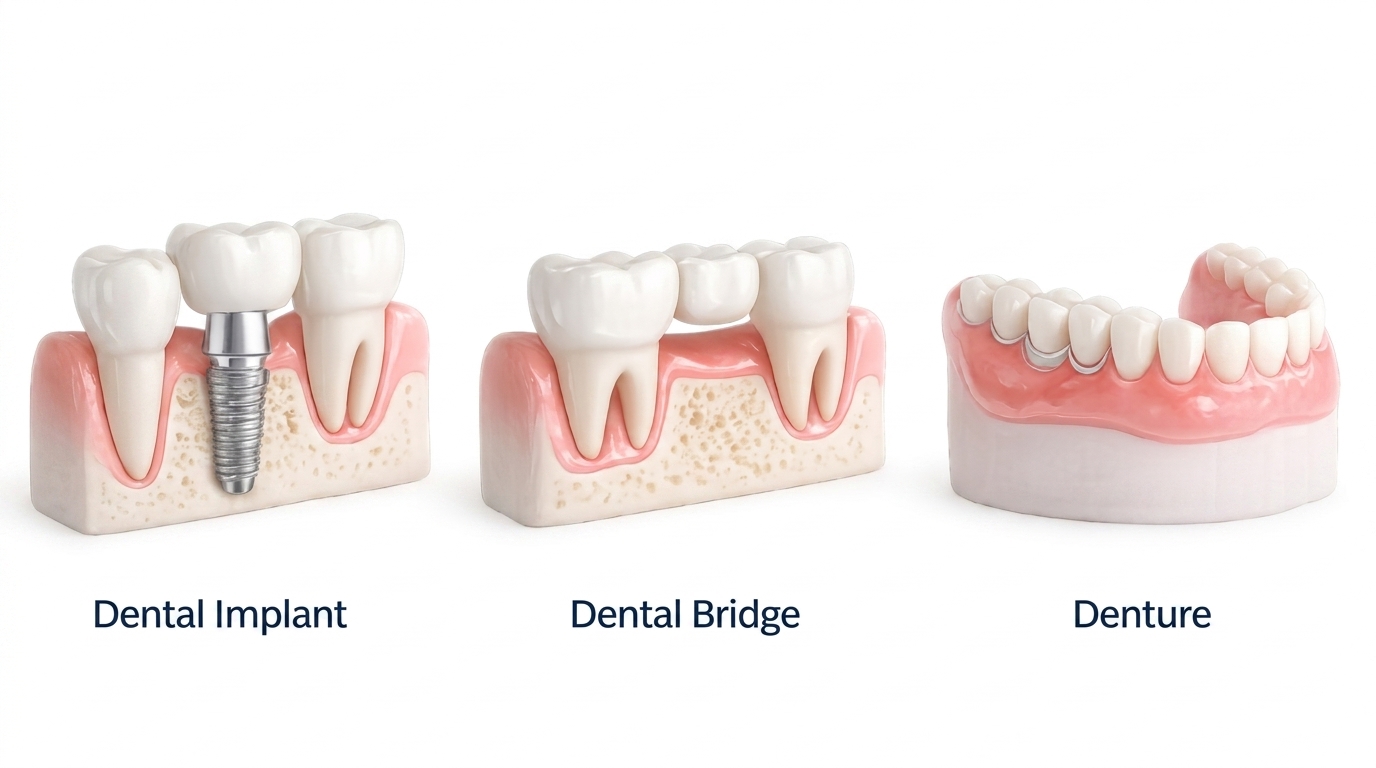
There are quite a few tooth replacement options now available in dentistry. The three options that get the most discussion are implants, bridges, and dentures.
The American Dental Association states that dental bridges, dentures and dental implants are the primary options when confronted with a situation of missing teeth, although it is a patient specific choice which option would be the best.
Missing teeth should be replaced for numerous functional and aesthetic reasons. Firstly, missing teeth can impact bite force and function, as well as the position of nearby teeth. Missing teeth can also weaken facial bone structure as well. Missing several teeth can cause people to be self-conscious about their smiles, as well as lead to missing the ability to bite and chew food comfortably. Someone’s facial structure can also suffer from missing several teeth. The sooner a person visits a dentist about missing teeth, the more options a patient will have for replacement.
Dental Implants
One such tooth replacement option is dental implants. These are posts that are surgically placed into the jawbone in order to serve as artificial tooth roots. The dental implant serves as an artificial tooth root, and when the integration of the implant into the jawbone has been completed, a crown or restoration can be attached to it.
Dentistry implants are fixed in place, offering stability.
Dental Bridges
Dental bridges fill the gap of missing teeth by using the supporting structures of adjacent or implant teeth. The bridge is made up of supporting crowns on the adjacent teeth and a fake tooth, or a pontic, in between.
A dental bridge can restore function and appearance of the teeth without the use of removable appliances.
Dentures
Dentures are removable dental prosthetics that replace missing teeth. If you are missing several teeth, you may receive partial dentures or full dentures to replace arches of missing teeth.
Comparison of Dental Implants, Dentures and Dental Bridges
Understanding the key differences between treatment options is vital when selecting a tooth replacement:
| Best suited for | Dental Bridges (One or several adjacent missing teeth) | Dentures (Several or all missing teeth) |
|---|
| Fixed vs Removable | Dental Bridges (Usually fixed) | Dentures (Usually removable) |
|---|
| Replaces Tooth Root | Dental Bridges (No) | Dentures (No) |
|---|
| Surgery Required | Dental Bridges (Usually no implant surgery) | Dentures (Usually no) |
|---|
| Jawbone Support | Dental Bridges (Not required for artificial tooth) | Dentures (Rests on gums/bone) |
|---|
| Feel & Appearance | Dental Bridges (Generally comfortable) | Dentures (May require adjustment) |
|---|
| Effect on Neighboring Teeth | Dental Bridges (Involves altering supporting teeth) | Dentures (Depends on design) |
|---|
| Maintenance | Dental Bridges (Brush and clean under bridge) | Dentures (Remove and clean regularly) |
|---|
Note: Costs and treatment times vary significantly between patients. The most appropriate option can only be determined with routine dental examinations and imaging.
Dental Implants: Pros and Cons
As more innovative solutions for tooth replacement enter the market, dental implants redefine what it means to replace a missing tooth by replacing the tooth root as well.
- A stable replacement for missing teeth
- Natural looking appearance and feel
- No mess situations like slippage due to denture adhesives
- Ability to replace individual teeth without affecting neighbors
- No need to alter healthy neighboring teeth
- Stimulate bone growth in the jaw
- Support other replacements including bridge work
- Permanently anchored to the jawbone
Dental Implants: Cons
There are several trade-offs to consider when evaluating dental implants:
For this reason, when people compare the costs of different dental solutions, it is even more important to assess how the pros and cons apply to you and your specific dental situation, rather than just looking for the cheaper option.
- Requires invasive surgery for placement
- Lengthy healing and osseointegration process
- Sufficient bone density and healthy tissue are essential
- Additional bone grafting surgery may be required
- Greater upfront financial expense
- Requires regular professional check-ups and maintenance
Dental Bridges: Pros and Cons
Bridges can be used to fill gaps in your smile and can be a long-term solution for multiple missing teeth. Depending on your dental needs, traditional bridges use surrounding healthy teeth for support while implant-supported bridges utilize implants. Make sure to understand how pros and cons apply specifically to your dental aesthetics and dental health.
Dental Bridge Advantages
Key benefits of opting for a dental bridge restoration include:
- Fixed restoration providing convenience and confidence
- No removable appliance needed
- Restores chewing function and bite force
- Treatment is often quicker than implant placement
- Effectively closes the gap from missing teeth
- Meets the preference of patients wanting to avoid surgery
Disadvantages of Dental Bridges
Potential drawbacks of dental bridges to keep in mind:
- Requires preparation and reduction of surrounding healthy teeth
- Requires careful hygiene to remove debris from underneath the pontic
- Does not replace missing tooth roots or prevent jawbone loss
- Not a permanent solution; may break or need replacement over time
Benefits Of Dentures
Even with the advances in other dental treatments, removable dentures remain a choice for patients that have lost a significant amount of their teeth. They can be used to completely replace one arch of teeth and can be taken out for easy plaque and food debris removal.
Advantages of Dentures
Advantages of selecting partial or complete dentures include:
- Allows replacement of multiple lost teeth across an arch
- Used to remedy extensive tooth loss efficiently
- Significantly less invasive than implant surgery
- Removable for straightforward denture cleaning
- Restores lost chewing capacity and facial support
- Generally less expensive initially
Disadvantages of Dentures
Dentures which are fitted properly should not be painful. Evaluation by a dentist is warranted for damaged or loose dentures.
- Orthodontic treatment will not make them less movable
- More cleaning and maintenance required than fixed restorations
- Can take time to get used to for speaking and chewing
- Periodic adjustments and relining may be needed
Which is Better: Dental Implant or Bridge?
If the option is to replace one missing tooth, an implant or a bridge can be considered. An implant is used to replace the natural root whereas in a traditional bridge the surrounding teeth will act as support.
An implant may be more appropriate when the adjacent teeth are healthy. A bridge would be a more appropriate choice if the surrounding teeth are already weakened and in need of a crown or if dental implant surgery is not preferred.
Which is Better: Dental Implant or Dentures?
Usually if a decision is to be made between a dental implant and dentures, the first thing to consider is the number of lost teeth.
A dental implant with a crown may be the choice for a missing tooth. For multiple missing teeth, either several implants or an implant supported denture would be more appropriate. Traditional dentures may be more useful for an entire row. Stability is increased over traditional dentures with implant supported dentures.
Bridge or Dentures: Which Is Better?
When a determination on bridge or dentures needs to be made, the number of missing teeth and their locations will play a role in the decision.
A bridge is made to cover a gap and is fixed. Dentures can be used to replace several teeth over a wider area and are removable. A missing tooth would be considered for a bridge. For multiple non adjacent teeth, a partial denture may be the more adaptable choice.
Dental Implants or Bridges: Which Is Better for One Missing Tooth?
For a single missing tooth, a dental implant or a bridge may both be adequate choices. A dental implant supports and replaces a root with a crown, while a traditional bridge is supported by neighboring teeth.
Because of factors such as adjacent tooth health, jawbone volume, gum health, treatment length, budget, and personal preference, an implant is frequently the more advisable long-term solution.
Dental Implants or Dentures: Which Is Better for Multiple Missing Teeth?
For multiple missing teeth, you have several choices depending on the pattern of tooth loss:
- Multiple individual dental implants
- Implant-supported bridge
- Partial denture
- Implant-retained dentures
- Fixed implant-supported restoration
What is the Cost of Dental Implants, Bridges and Dentures?
Providing one single figure for cost is misleading because price is impacted by many factors including missing teeth count, materials, diagnostic imaging, extractions, bone grafting, lab work, and complexity.
It may be initially less costly to utilize dentures, but the total final cost over a lifetime may differ once relining, replacements, and long-term maintenance are taken into account.
Fixed vs. Removable Options
Permanent fixed solutions include dental implants & crowns, traditional bridges, implant-supported bridges, and fixed implant restorations. Removable options include complete dentures, partial dentures, and removable implant-supported dentures.
Fixed options offer maximum convenience and stability, while removable solutions provide flexibility, coverage for extensive tooth loss, and lower initial costs.
What Factors Should You Consider Before Choosing?
Your dentist will analyze several factors before suggesting a treatment option:
- Number of missing teeth (single tooth vs multiple teeth)
- Location of missing teeth (front aesthetic zone vs back molars)
- Gum health and presence of periodontal disease
- Health and volume of jawbone density
- Structural condition of neighboring supporting teeth
- Initial cost versus long-term lifetime value
- Desired treatment timeline and speed of completion
- Lifestyle preference (fixed stability vs removable convenience)
What Happens During a Tooth Replacement Consultation?
A professional assessment helps determine how to replace a missing tooth safely and efficiently. Your dentist will conduct a detailed exam, review dental history, and order X-rays or 3D imaging if needed.
The consultation includes checking gums, remaining teeth, bite evaluation, bone assessment for implants, discussing expectations, comparing treatment choices, estimating timeline, and outlining post-treatment care.
Can Missing Teeth Affect Your Remaining Teeth?
Absolutely. The American Dental Association (ADA) notes that remaining teeth can shift into vacant spaces created by missing teeth. Missing teeth alter bite patterns, change how remaining teeth meet, affect chewing comfort, and can lead to surrounding jawbone loss.
Which Option Looks Most Natural?
All three options can look highly aesthetic when properly planned. Dental implants appear the most natural because the crown emerges directly from the gumline like a natural tooth. Bridges blend seamlessly when matched to adjacent teeth. Customized modern dentures also approximate natural teeth and gums.
Which Option Requires Less Maintenance?
Dental implants are highly stable and can never develop cavities, though surrounding gums still require routine hygiene. Bridges require cleaning underneath the pontic. Conventional dentures are the least stable but can be upgraded to implant-supported dentures for improved security and function.
Common Mistakes to Avoid When Replacing Missing Teeth
Avoid making major decisions based solely on advertisements or upfront price tags alone:
- Choosing a treatment without a thorough clinical exam
- Comparing prices instead of full service quality
- Failing to treat active gum disease prior to restorations
- Delaying replacement treatment indefinitely
- Assuming one solution fits everyone without personalized advice
Why Consider Dentacare for Your Tooth Replacement in Bilekahalli, Bengaluru?
If you are searching for a dental clinic near Bilekahalli, dentist near me, or specialist dental implant and bridge care in Bengaluru, Dentacare provides personalized, patient-centered dentistry backed by years of clinical experience.
Located conveniently in Bilekahalli, Bengaluru, our dental team evaluates your exact oral health condition and guides you toward the most reliable, comfortable, and long-lasting tooth replacement.
Frequently Asked Questions
Which is better; a dental implant or a dental bridge?
After replacing the tooth root, many believe dental implants offer longer-term independence than dental bridges, however, bridges are the preferred method depending on the health of the patient, the adjacent teeth, time required for treatment, the bone, and budget.
Are dental implants or dentures better?
Dentures are a better option than dental implants to replace several teeth, and especially all teeth, in cases where surgery is not a viable option. Dental implants do offer greater stability, but surgical placement requires a greater investment and more maintenance.
How long do dental bridges last?
Proper care of dental bridges will ensure several years of function; however, the time will vary due to the quality of the supporting teeth, how well the patient takes care of their mouth, bite forces, materials, and how regularly they have check-ups at the dentist.
Can several missing teeth be replaced by dental implants?
That can certainly be done. Dental implants can support multiple implants to hold crowns, bridges, or implant-held dentures.
Do modern dentures look like natural teeth?
Custom dental prosthetics can certainly look natural, and it is about selecting materials, designs, and tooth arrangements to reflect your wishes and how well they’ve been made.
What is the least expensive replacement for a missing tooth?
For many dental patients, the first cost of dentures is less than dental implants. However, there are many factors which would require treatment planning by a licensed dental professional.
Can bone loss patients receive dental implants?
In many situations significant loss of bone would preclude a patient from receiving a dental implant, however in some cases a patient may become a candidate for implant placement after bone grafting.